Birmingham: One of the UK’s Leading Cities for Muslim Life
Birmingham holds a special place in Muslim life in the United Kingdom. As one of England’s largest cities, it is home to a large, long-established and remarkably diverse Muslim community.
For anyone researching where to live in the UK as a Muslim, or for families looking for a city where mosques, halal food and Islamic education are easily accessible, Birmingham naturally deserves serious consideration.
Unlike destinations where Muslim life is centred around only a handful of mosques or isolated halal businesses, Birmingham has entire neighbourhoods where Muslim community life is part of the everyday environment.
Almost One in Three Birmingham Residents Is Muslim
The 2021 Census demonstrates the scale of Birmingham’s Muslim population.
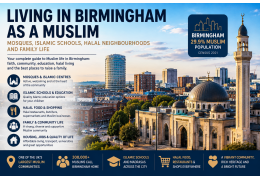
Around 29.9% of Birmingham residents identified as Muslim, representing approximately 342,000 people.
For comparison, Muslims accounted for around 21.8% of the city’s population in the 2011 Census.
Over just ten years, Birmingham’s Muslim population therefore continued to become an increasingly significant part of the city’s demographic landscape.
But city-wide statistics tell only part of the story.
Muslims are not distributed evenly across Birmingham. In some neighbourhoods, they represent a very large majority of local residents.
This is particularly visible in and around areas such as Small Heath, Alum Rock, Bordesley Green, Sparkhill, Sparkbrook and Balsall Heath.
We will examine these areas in detail later in this guide.
A Muslim Community Established Over Several Generations
Birmingham did not become a major Muslim city recently.
A significant part of its Muslim community developed through post-war migration, particularly with workers arriving from the Indian subcontinent during the second half of the twentieth century.
Over time, families settled permanently, new generations were born in Britain, businesses were created and Islamic institutions developed.
Today, Birmingham’s Muslims come from many different backgrounds, including communities with roots in Pakistan, Bangladesh, India, the Arab world, Africa, Turkey, Europe and many other regions.
The city is also home to British converts to Islam and to second, third and later generations of Muslims who were born and raised in the United Kingdom.
This diversity is one of the defining characteristics of Muslim Birmingham today.
Birmingham Neighbourhoods Where Muslim Life Is Highly Visible
In some parts of Birmingham, the scale of the Muslim community becomes obvious within minutes of walking through the neighbourhood.
Families can find:
mosques, madrasahs, Islamic schools, halal butchers, international supermarkets, halal restaurants, Muslim clothing shops, Islamic bookshops and community organisations.
Major commercial streets such as Coventry Road, Stratford Road, Ladypool Road and Alum Rock Road have become particularly well known for their concentration of shops, restaurants and services.
For Muslim families, this can make everyday religious life considerably easier.
Halal shopping, Qur’an classes, mosque attendance and community activities can sometimes all be found within the same general area.
Mosques That Have Become Community Institutions
Birmingham also has an extensive network of mosques and Islamic centres.
Some of its best-known institutions include Birmingham Central Mosque, Green Lane Masjid and Community Centre, and Jami Mosque and Islamic Centre Birmingham.
Many of these organisations provide much more than the five daily prayers and Jumu’ah.
Depending on the institution, families may find Qur’an classes, Hifz programmes, Islamic studies, youth activities, women’s programmes, lectures, charitable projects and family support.
This infrastructure is an important distinction.
Having a large Muslim population is one thing; having established institutions capable of supporting Muslim families across different stages of life is another.
Birmingham increasingly offers both.
Halal Life Is Part of Everyday Birmingham
Another major advantage is the accessibility of halal food.
Birmingham has a substantial network of halal restaurants, butchers, supermarkets and international grocery stores.
The variety reflects the diversity of the city’s Muslim population.
Pakistani, Bangladeshi, Afghan, Arab, Syrian, Turkish and African food can be found alongside halal grills, burgers, desserts and contemporary dining.
For families, however, the biggest advantage is not simply having a large choice of restaurants.
It is the ability to make halal food part of normal everyday shopping without constantly travelling long distances to find suitable products.
Is Birmingham Really a Good City for Muslims?
The size of its Muslim population and the strength of its Islamic infrastructure clearly make Birmingham one of the most interesting British cities to examine when researching Muslim life in the UK.
However, a large Muslim population does not mean that every Birmingham neighbourhood offers the same experience.
That is why this guide goes far beyond simply listing mosques and halal restaurants.
Across 7 focused parts, we will explore Birmingham’s Muslim history, its main Muslim areas, major mosques and Islamic centres, Islamic schools and madrasahs, Qur’an and Hifz education, halal food, Ramadan, Eid and Muslim community life.
We are deliberately keeping questions such as housing prices, rent, employment, universities and transport for our separate guide dedicated to moving to Birmingham as a Muslim family.
First, however, we need to understand how Birmingham developed into one of the most important centres of Muslim life in the United Kingdom.
In Part 2, we will explore the history and development of Birmingham’s Muslim community, from post-war migration and the first prayer spaces to the established Islamic institutions seen across the city today.
How Birmingham’s Muslim Community Developed: From Migration to an Established British Muslim City
To understand why Birmingham is home to one of the largest Muslim communities in the United Kingdom today, we need to look back several decades.
Modern Muslim life in Birmingham is the result of a long history of migration, employment, family settlement, mosque building, entrepreneurship and religious transmission across generations.
Over time, Birmingham developed from an industrial city attracting Muslim workers into a major British city where Islam is now firmly established within its religious, social and cultural landscape.
Birmingham’s Industries Attracted New Workers
After the Second World War, Britain needed workers to support its expanding economy and industries.
Birmingham, with its strong manufacturing and industrial sectors, became an important destination for people seeking employment.
From the 1950s and particularly during the 1960s, workers from the Indian subcontinent began settling in Birmingham in significant numbers.
Many came from Pakistan, while others had roots in areas that are now part of Bangladesh and India.
For many of these early migrants, the initial objective was primarily economic: to work, earn money and improve conditions for their families.
What may initially have been viewed as temporary migration, however, gradually became permanent settlement.
From Migrant Workers to Established Families
One of the most important changes occurred as families began joining the first generation of workers.
Wives and children arrived in Britain, while new generations were born directly in Birmingham.
The needs of the community consequently changed.
Finding employment and accommodation was no longer enough.
Families increasingly needed places to pray, Qur’an education for their children, halal food, community organisations and institutions capable of preserving and transmitting their Islamic faith.
This period laid much of the foundation for the Muslim Birmingham we know today.
From Small Prayer Spaces to Established Mosques
The early Muslim communities did not immediately have access to the large Islamic institutions visible across Birmingham today.
As happened in many European cities, Muslims initially adapted the spaces available to them.
Homes, community rooms and converted buildings could serve as places for prayer and gathering.
As the Muslim population grew, so did the need for permanent religious institutions.
Communities began acquiring, converting and eventually developing buildings specifically for Islamic worship and education.
The history of Birmingham Central Mosque illustrates this transformation particularly well.
Construction of its mosque building was completed in 1969, before its official opening in 1975.
It would become one of the most recognisable symbols of Birmingham’s established Muslim presence.
The 1970s and 1980s: Building Community Institutions
As Birmingham’s Muslim population expanded, more mosques, madrasahs and community organisations appeared.
Jami Mosque and Islamic Centre Birmingham (JMIC), for example, was established in 1973 by members of Birmingham’s Bangladeshi community.
Its development shows how religious and educational needs increasingly became connected.
An evening maktab was established in 1975, followed by a Hifz madrasah in 1978.
Similar developments occurred across different parts of Birmingham as local Muslim communities established their own mosques, Qur’an classes, madrasahs and organisations.
The city was no longer dependent on a small number of prayer spaces.
A genuine Islamic community infrastructure was beginning to emerge.
Muslim Businesses Helped Transform Birmingham’s Neighbourhoods
Birmingham’s Muslim history was not built only around mosques.
As families settled permanently, Muslim entrepreneurship also became increasingly visible.
Halal butchers, grocery shops, restaurants, clothing businesses and specialist services developed in neighbourhoods with growing Muslim populations.
Commercial corridors such as Coventry Road, Stratford Road and Alum Rock Road gradually became important centres of local business.
These streets are significant because they demonstrate how Muslim communities helped shape not only Birmingham’s religious landscape but also the commercial character of several neighbourhoods.
Businesses established to serve local families eventually became part of Birmingham’s wider multicultural identity.
Birmingham’s Muslim Population Became Increasingly Diverse
Migration from the Indian subcontinent remains fundamental to the history of Islam in Birmingham, but the city’s Muslim population has become much more diverse over time.
Today, Birmingham is home to Muslims with family roots across the Middle East, Africa, Turkey, Europe and many other regions of the world.
British people have also embraced Islam, adding another dimension to the city’s Muslim community.
As a result, there is no single culture that can accurately represent “Muslim Birmingham”.
Different languages, foods, traditions and community histories exist alongside a shared Islamic faith.
This diversity can now be seen in the city’s mosques, businesses, restaurants and community organisations.
Second, Third and Later Generations of British Muslims
Perhaps the most important development is generational change.
The story of Birmingham’s Muslims can no longer be described simply as a story of immigration.
Many Muslims living in Birmingham today were born and raised in Britain, and in some families their parents were born in Britain as well.
They have attended British schools and universities, built careers, created businesses and raised their own families in Birmingham.
The priorities of the community have therefore evolved.
Earlier generations were often focused on establishing places of worship and ensuring that their children could learn the Qur’an.
Later generations face additional questions around education, British Muslim identity, youth, family life, professional development and transmitting Islam to future generations.
From Prayer Spaces to a Complete Muslim Ecosystem
Over several decades, Birmingham has therefore undergone a remarkable transformation.
The communities established by earlier Muslim workers gradually developed into a population rooted across multiple generations.
Around them grew an extensive network of:
mosques, Islamic centres, madrasahs, schools, halal businesses, restaurants, charities and community organisations.
This history helps explain why Birmingham now possesses such a developed Muslim infrastructure.
But Muslim life is not distributed equally throughout the city.
Several neighbourhoods have particularly large Muslim populations and have become major centres of Islamic community life.
In Part 3, we will explore Birmingham’s main Muslim areas — including Small Heath, Alum Rock, Bordesley Green, Sparkhill, Sparkbrook and Balsall Heath — and see how Muslim life differs across these parts of the city.
Birmingham’s Main Muslim Areas: Small Heath, Alum Rock, Sparkhill, Sparkbrook, Bordesley Green and Balsall Heath
When people search for the best Muslim areas in Birmingham or ask where Birmingham’s Muslim community is concentrated, several names appear repeatedly: Small Heath, Alum Rock, Bordesley Green, Sparkhill, Sparkbrook and Balsall Heath.
There is a good reason for this.
Data from the 2021 Census shows particularly large Muslim populations across several parts of east and south-east Birmingham. In some wards, Muslims represent a substantial majority of local residents.
However, describing Birmingham as having one single “Muslim neighbourhood” would be misleading.
The city has several major centres of Muslim community life, each with its own location, commercial streets and local character.
Small Heath: One of the Hearts of Muslim Birmingham
Small Heath is probably one of the best-known areas when discussing Muslim life in Birmingham.
According to local 2021 Census data, around 85.9% of Small Heath ward residents identified as Muslim.
This exceptionally large Muslim population is visible throughout the neighbourhood.
Mosques, halal businesses, restaurants and services used by Muslim families form an important part of the local environment.
One of the area’s main landmarks is Coventry Road.
This long commercial corridor is home to numerous restaurants, supermarkets, butchers and independent businesses.
Small Heath is also associated with several important Islamic institutions.
For someone visiting Birmingham specifically to understand its Muslim community, Small Heath and Coventry Road are among the most useful places to explore first.
Alum Rock: A Major Muslim Community in East Birmingham
Further east, Alum Rock is another major centre of Muslim life.
According to local 2021 Census figures, approximately 83.7% of residents in Alum Rock ward identified as Muslim.
Once again, the community’s presence is clearly reflected in everyday neighbourhood life.
Alum Rock Road is one of the area’s main commercial arteries.
Food businesses, restaurants, clothing stores and independent shops line the road, serving both local residents and visitors from surrounding areas.
For Muslim families living nearby, this concentration can make everyday life considerably more convenient.
Alum Rock is therefore an important area to understand for anyone researching Muslim neighbourhoods in Birmingham, particularly beyond the better-known Small Heath.
Bordesley Green: Part of Birmingham’s Muslim East
Bordesley Green may be less internationally recognised than Small Heath, but its Muslim population is also particularly significant.
Around 80.2% of Bordesley Green ward residents identified as Muslim in the 2021 Census.
Its location is one of its most interesting characteristics.
Bordesley Green sits close to several other areas with large Muslim populations.
Rather than viewing Small Heath, Bordesley Green and Alum Rock as completely separate communities, it can be more useful to see them as part of a wider concentration of Muslim neighbourhoods across east Birmingham.
Residents can therefore benefit from mosques, businesses and community services located across several neighbouring areas.
Sparkhill: Muslim Life Around Stratford Road
South-east of Birmingham city centre, Sparkhill is another important centre of Muslim life.
Around 79.2% of Sparkhill ward residents identified as Muslim according to local 2021 Census data.
One of the defining features of the area is Stratford Road.
This major commercial route runs through several multicultural neighbourhoods and contains restaurants, supermarkets, butchers and a wide variety of independent shops.
Sparkhill consequently has its own distinct character while still offering the extensive Muslim infrastructure associated with other parts of Birmingham.
Sparkbrook: An Established Community Close to Central Birmingham
Neighbouring Sparkbrook has a long history of migration and multicultural settlement.
Muslim community life remains an important part of the area today.
Its relative proximity to central Birmingham can also make Sparkbrook particularly interesting.
Residents have access to the commercial environments around Stratford Road and Ladypool Road, while remaining connected to other parts of the city.
The wider area is also home to Islamic religious and educational institutions.
This combination of community life, local businesses and proximity to central Birmingham helps explain Sparkbrook’s continuing importance within Muslim Birmingham.
Balsall Heath and Ladypool Road
Close to Sparkbrook, Balsall Heath is another historically multicultural area with a substantial Muslim population.
In the Sparkbrook & Balsall Heath East ward, around 77.4% of residents identified as Muslim in the 2021 Census.
One of the best-known local commercial streets is Ladypool Road.
The area is historically associated with Birmingham’s famous Balti Triangle, but its importance extends beyond restaurants.
Together with neighbouring Sparkbrook and Sparkhill, Balsall Heath forms part of a wider commercial and community environment strongly influenced by Birmingham’s South Asian and Muslim populations.
Birmingham Does Not Have Just One “Muslim Area”
This is one of the most important things to understand about the city.
Birmingham does not have a single Muslim district surrounded by neighbourhoods with little Islamic presence.
Instead, it has several substantial areas.
Broadly speaking, two major concentrations are particularly visible:
East Birmingham: Small Heath, Bordesley Green and Alum Rock.
South-east Birmingham: Sparkhill, Sparkbrook and Balsall Heath.
Muslims also live throughout many other areas of Birmingham, of course.
But these concentrations help explain why the city has developed such extensive Muslim infrastructure.
Community life is not dependent on one single neighbourhood.
Which Muslim Area Should You Explore First?
If you are visiting Birmingham specifically to understand Muslim life in the city, a simple route can reveal a great deal.
Start with Small Heath and Coventry Road, before exploring Alum Rock Road.
On another day, visit Sparkhill and Stratford Road, then continue towards Sparkbrook, Ladypool Road and Balsall Heath.
Across these areas, you will see different sides of Muslim Birmingham: family life, independent businesses, halal food, mosques and community institutions.
However, population statistics alone do not create a strong Muslim community.
The institutions that serve these neighbourhoods are equally important.
In Part 4, we will therefore explore some of the major mosques and Islamic centres in Birmingham, what they offer and why their role often extends far beyond the five daily prayers.
Major Mosques and Islamic Centres in Birmingham
The strength of Birmingham’s Muslim community cannot be measured only by the number of Muslims living in the city.
One of Birmingham’s greatest advantages is its extensive network of mosques and Islamic centres, some of which have developed into major religious, educational and community institutions.
In Birmingham, a mosque can be far more than a place for the five daily prayers and Jumu’ah. Depending on the institution, families may also find Qur’an education, Hifz programmes, youth activities, women’s programmes, family support, Nikah services, food assistance and Islamic funeral services.
Among Birmingham’s many mosques, three institutions are particularly useful for understanding the scale of Muslim community infrastructure in the city: Birmingham Central Mosque, Green Lane Masjid and Community Centre, and Jami Mosque and Islamic Centre Birmingham.
Birmingham Central Mosque: A Landmark of Muslim Birmingham
Birmingham Central Mosque is one of the best-known Islamic institutions in the city.
Its importance is both historical and community-based.
Today, the mosque provides a broad range of services, including madrasah education, family support, Nikah and marriage services, mosque visits and tours, access to an imam, funeral services, food assistance and support for people interested in embracing Islam.
This range of services demonstrates how major British mosques have evolved over several generations.
They are not simply places where Muslims gather for salah.
They can accompany individuals and families through many different stages of life.
Qur’an, Arabic, Islamic Studies and Hifz
Education is an important part of Birmingham Central Mosque’s work.
Its madrasah operates during weekday evenings and at weekends, providing children with opportunities to study subjects including Qur’an, Arabic, Islamic Studies and Hifz.
For Muslim families, this type of infrastructure can be extremely useful.
Children attending mainstream British schools during the day can continue their Islamic education several times each week through a local mosque or madrasah.
We will explore Birmingham’s Islamic education options in greater detail in Part 5.
Green Lane Masjid and Community Centre in Small Heath
In Small Heath, Green Lane Masjid and Community Centre is another major Birmingham Islamic institution.
Located at 20 Green Lane, it sits close to one of the city’s largest concentrations of Muslim residents.
Its name is significant: it operates as both a masjid and a community centre.
Alongside prayer and religious education, the organisation has developed activities and services aimed at different sections of the community.
These have included youth activities, programmes for women, sports, welfare support and community initiatives.
It also provides counselling designed to offer emotional, psychological and spiritual support.
For Muslim families, this illustrates why simply counting the number of mosques in a neighbourhood does not tell the whole story.
The more useful question is:
What does the mosque actually provide for families and the wider community?
Jami Mosque and Islamic Centre Birmingham: More Than 50 Years of Community History
On Coventry Road, another important institution is Jami Mosque and Islamic Centre Birmingham (JMIC).
JMIC was established in 1973 by members of Birmingham’s Bangladeshi community.
Over more than five decades, it has developed into a substantial religious, educational and community centre.
Its facilities include large prayer areas and dedicated prayer facilities for women.
Education has also played an important role throughout its history.
Its evening maktab began in 1975, followed by the establishment of a Hifz madrasah in 1978.
Today, its educational facilities include multiple classrooms capable of serving hundreds of students.
Supporting Muslims Through Different Stages of Life
JMIC provides a range of religious and community services alongside daily prayer and Jumu’ah.
These include Islamic education, religious guidance, Nikah and civil marriage services, Islamic funeral support and food assistance.
This is particularly interesting from a historical perspective.
An institution originally established by an earlier generation of Birmingham Muslims can now serve their children, grandchildren and subsequent generations.
The mosque therefore becomes a place of religious continuity and transmission across generations.
Birmingham’s Local Mosques Matter Too
Birmingham Central Mosque, Green Lane Masjid and JMIC are useful examples, but they represent only a small part of Birmingham’s Islamic landscape.
Across Small Heath, Alum Rock, Sparkhill, Sparkbrook, Bordesley Green, Balsall Heath and other areas, many local mosques serve neighbourhood communities every day.
Some may be much smaller and less well known online.
For local families, however, they can be just as important.
A mosque within walking distance of home can sometimes be more practical than a famous Islamic centre several miles away, particularly when children attend Qur’an classes multiple times each week.
What Makes a Mosque Family-Friendly?
Muslim families exploring Birmingham should therefore look beyond the size or reputation of a mosque.
Useful questions include:
Does it provide Qur’an classes for children?
Are there facilities and programmes for women?
Are activities available for teenagers and young adults?
Does the mosque organise lectures and education for adults?
Are there family and welfare services?
Can the mosque be reached easily from home?
These factors help distinguish a prayer space from a genuine centre of Muslim community life.
Birmingham offers numerous examples of both large Islamic institutions and smaller neighbourhood mosques that fulfil these roles.
Mosques, Religious Transmission and Birmingham’s Future
The history of Birmingham’s mosques reflects the wider development of its Muslim population.
Earlier generations needed places where they could pray and ensure that their children learned the Qur’an.
Several decades later, some of those institutions now provide education, youth programmes, family support, charity and social services while continuing to fulfil their fundamental religious role.
This is one of the reasons Birmingham has developed such a structured Muslim community.
For parents, however, religious transmission does not end at the mosque door.
In Part 5, we will focus specifically on Islamic schools, madrasahs, Qur’an classes and Hifz programmes in Birmingham, and explore the different educational options available to Muslim families.
Islamic Schools, Madrasahs, Qur’an Classes and Hifz in Birmingham
For Muslim families, children’s education is often one of the most important considerations when exploring a new city.
Birmingham has a significant advantage in this area: parents are not limited to a single educational model. Families can choose between full-time Islamic schools, mainstream British schools combined with evening or weekend madrasahs, Qur’an classes and dedicated Hifz programmes.
This range of options is one of the reasons Birmingham can be particularly attractive to Muslim families raising children in the United Kingdom.
Al-Ameen Primary School: Islamic Primary Education in Birmingham
Al-Ameen Primary School is an independent Islamic primary school in Birmingham that also provides early-years education.
The school aims to combine academic learning with an environment shaped by Islamic values.
For parents, the main difference between this model and supplementary Islamic education is that religion is not restricted to classes after the normal school day.
Islamic identity forms part of the child’s everyday educational environment.
Al-Ameen notes that demand for places can be high and operates waiting arrangements when places are unavailable.
As an independent school, tuition fees apply. Families considering the school should always verify the latest fees, admissions criteria, availability and inspection information directly before making a decision.
Darul Uloom Islamic High School in Small Heath
For secondary education, Darul Uloom Islamic High School is another established option.
Located on Coventry Road in Small Heath, the independent school serves boys aged 11 to 16.
Its educational model combines academic subjects with Islamic education.
Its location is particularly relevant to families living in Small Heath because, as we explored earlier, Coventry Road sits within one of Birmingham’s most established Muslim areas.
This illustrates an important point for parents: the choice of school, mosque, madrasah and neighbourhood can be closely connected.
Jamia Islamia Birmingham
Jamia Islamia Birmingham, located in the Sparkbrook area, provides another Islamic educational option for boys.
The institution combines secondary education with an Islamic learning environment.
However, parents should never select a school simply because the word “Islamic” appears in its name.
Every institution should be evaluated individually.
Families should consider academic standards, safeguarding, the Islamic curriculum, admissions, inspection reports, fees, facilities and whether the school is genuinely suitable for their child.
Inspection results and school circumstances can change over time, so recent official information is much more useful than an old reputation or online comment.
Mainstream School + Madrasah: Another Popular Option
Not every Muslim family in Birmingham chooses a full-time Islamic school.
Another common model is:
mainstream school during the day + Qur’an or madrasah classes after school and at weekends.
This approach gives parents access to a much larger range of schools while allowing Islamic education to continue separately.
Birmingham’s extensive mosque and madrasah network makes this model particularly practical.
A family may choose a mainstream school based on academic quality and location, then select an Islamic centre according to the type of Qur’an and religious education it provides.
Qur’an, Arabic and Islamic Studies
Supplementary Islamic education in Birmingham can cover much more than basic Qur’an reading.
Depending on the institution and programme, children may study:
Qur’an recitation, Tajweed, Arabic, Islamic Studies, Adab, Akhlaq and memorisation.
Birmingham Central Mosque, for example, operates a madrasah for children and provides Qur’an and Islamic education during weekday evenings and weekends.
For children attending mainstream schools, structured programmes like these can make Islamic education a regular part of the week rather than an occasional activity.
Hifz Programmes in Birmingham
Some families specifically want their children to memorise the entire Qur’an.
Birmingham offers Hifz and Tahfeez programmes through different Islamic institutions.
Birmingham Central Mosque includes a dedicated memorisation pathway, while other Islamic centres across the city also provide Qur’an memorisation programmes at different levels.
This means families can search for a programme that matches the child’s age, Qur’an level, learning pace and long-term objectives.
Hifz is a substantial commitment, so parents should also consider the balance between memorisation, schoolwork, rest and family life.
Islamic Education for Adults
Islamic learning in Birmingham is not limited to children.
Mosques and Islamic organisations also provide opportunities for adults to continue learning through Qur’an circles, Islamic classes, lectures and programmes for new Muslims.
This is another advantage of having a large and established Muslim community.
Islamic education can potentially accompany a person through childhood, adolescence and adulthood.
Islamic School or Madrasah: Which Is Better?
There is no single answer that applies to every Muslim family.
A full-time Islamic school may provide a more consistently Islamic educational environment throughout the day.
A mainstream school combined with a strong local madrasah can offer greater choice in academic schooling while maintaining structured Islamic learning.
Another family may prioritise Hifz.
The right decision depends on factors including:
the individual child, academic needs, religious priorities, school quality, family budget, available places and travel distance.
The important point is to evaluate the actual institution rather than choosing purely on its name or general reputation.
A Strong Islamic Education Infrastructure
This variety is ultimately one of Birmingham’s major strengths for Muslim families.
Parents can explore several different educational paths:
full-time Islamic school, mainstream school with madrasah, Qur’an classes, Tajweed, Arabic, Islamic Studies or Hifz.
Not every option will suit every child, but having genuine choice is valuable.
After exploring Birmingham’s Muslim neighbourhoods, mosques and Islamic education, we now turn to one of the most visible aspects of everyday Muslim life in the city.
In Part 6, we will explore halal life in Birmingham — restaurants, butchers, supermarkets and major Muslim shopping areas such as Coventry Road, Stratford Road, Ladypool Road and Alum Rock Road.
Halal Life in Birmingham: Restaurants, Butchers, Supermarkets and Muslim Shopping Streets
After mosques and Islamic education, one of the most visible aspects of Muslim life in Birmingham is the city’s extensive halal food and shopping scene.
In some European cities, finding a halal butcher, supermarket or good selection of halal restaurants can require travelling across the city.
Birmingham is very different.
Several neighbourhoods have developed major commercial areas where halal restaurants, butchers, international supermarkets, bakeries, cafés and Muslim-owned businesses can all be found relatively close together.
Four names are particularly important when exploring halal Birmingham:
Coventry Road, Stratford Road, Ladypool Road and Alum Rock Road.
Coventry Road and Small Heath: One of Birmingham’s Main Halal Hubs
In Small Heath, Coventry Road is one of the best places to experience Birmingham’s halal food culture.
The long commercial road is home to restaurants, supermarkets, butchers and numerous independent businesses.
Its food scene reflects the diversity of Birmingham’s Muslim population.
One example is Syrian House, located at 392 Coventry Road, offering Syrian cuisine in the heart of Small Heath.
Further along Coventry Road, Fenous is another established restaurant and is listed by Birmingham Halal as a confirmed halal venue.
But Coventry Road’s real strength is not one particular restaurant.
It is the density of Muslim-friendly businesses.
A family can potentially eat out, buy halal groceries, visit local shops and access other community services without travelling across Birmingham.
Alum Rock Road: Halal Shopping in East Birmingham
Further east, Alum Rock Road forms another major Muslim commercial corridor.
Because Alum Rock and the surrounding neighbourhoods have such large Muslim populations, halal food is deeply integrated into everyday shopping.
Families can find businesses such as Birmingham Halal Meat, a butcher on Alum Rock Road, alongside Al Halal Supermarket, supermarkets, grocery shops, restaurants and takeaways.
For local residents, this makes an important difference.
Buying halal meat or specialist ingredients does not necessarily require a special weekly journey.
For many households, it can simply be part of their normal neighbourhood shopping routine.
Stratford Road and Sparkhill
South-east of Birmingham city centre, Stratford Road provides another major concentration of restaurants and Muslim businesses.
The road connects several multicultural areas around Sparkhill and Sparkbrook.
One of its best-known restaurants is Mughal-e-Azam Restaurant & Banqueting, which occupies a distinctive former church building on Stratford Road.
The area also includes other halal dining options, from traditional South Asian restaurants to Middle Eastern food and more contemporary concepts.
This diversity is important.
The halal food scene in Birmingham is no longer limited to traditional curry houses.
Muslim consumers can now choose from a much wider range of dining styles.
Ladypool Road and Birmingham’s Famous Balti Heritage
Close to Sparkbrook and Balsall Heath, Ladypool Road is another important destination for halal food.
The surrounding area is historically associated with Birmingham’s famous Balti Triangle, an important part of the city’s South Asian culinary history.
Today, Ladypool Road remains a busy restaurant and shopping destination.
Current halal options include establishments such as Tawa King and Al Bader Restaurant, alongside many other restaurants, cafés and dessert businesses.
Together, Ladypool Road, Stratford Road and the surrounding Sparkbrook and Balsall Heath areas form one of Birmingham’s most important Muslim dining environments.
Birmingham’s Halal Scene Goes Far Beyond Restaurants
When discussing halal life in Birmingham, however, focusing only on restaurants would miss the most important point for families.
For someone who actually lives in the city, butchers and supermarkets are far more important on a daily basis.
Established Muslim neighbourhoods provide access to halal meat, fruit and vegetables, rice, spices, bread and ingredients used across South Asian, Middle Eastern, African and Mediterranean cuisines.
This allows families from different backgrounds to maintain their own cooking traditions while following their halal requirements.
A Remarkably Diverse Halal Food Scene
Birmingham’s Muslim population is extremely diverse, and its food reflects that diversity.
Across the city, it is possible to find cuisine influenced by Pakistan, Bangladesh, Afghanistan, Syria, the Arab world, Turkey, Africa and other regions, alongside halal burgers, steaks, pizzas, grills, brunches and desserts.
A local Birmingham halal guide updated in July 2026 continues to list verified halal restaurants across Small Heath, Alum Rock, Sparkhill, Balsall Heath and other areas of the city.
Halal food is therefore not a small specialist niche in Birmingham.
In several neighbourhoods, it is simply part of the normal local food scene.
Always Check the Halal Status
Despite the enormous choice available, Muslim consumers should still verify the halal status of individual businesses.
A restaurant should never be assumed to be fully halal simply because it is located in Small Heath, Sparkhill or another heavily Muslim area.
Ownership, menus, meat suppliers and certifications can change.
If you follow particular halal certification or slaughter requirements, ask the business directly about:
its meat supplier, certification, preparation methods and whether the entire menu is halal.
Recent specialist halal directories can be useful for discovering restaurants, but direct verification remains the safest approach when particular standards matter to you.
Which Birmingham Area Is Best for Halal Food?
There is no single answer because Birmingham has several strong halal areas.
Small Heath and Coventry Road offer a particularly dense concentration of restaurants and Muslim businesses.
Alum Rock Road combines halal food with the everyday grocery shopping needs of local families.
Sparkhill and Stratford Road provide another extensive restaurant and shopping corridor.
And Ladypool Road, Sparkbrook and Balsall Heath combine a large halal food scene with Birmingham’s historic Balti heritage.
This geographical spread is one of Birmingham’s greatest strengths.
Muslim families are not dependent on one small halal district.
Several different parts of the city have developed their own substantial food and shopping infrastructure.
For families, that convenience becomes important every single week.
Birmingham therefore brings together many of the foundations of everyday Muslim life: established Muslim neighbourhoods, mosques, Islamic education and extensive access to halal food.
In Part 7, the final part of this first Birmingham guide, we will see how these elements come together through Ramadan, Eid, youth activities, women’s programmes, charity and Muslim family life, before introducing our separate guide dedicated to actually moving to Birmingham.
Ramadan, Eid and Muslim Community Life in Birmingham
After exploring Birmingham’s Muslim history, main Muslim neighbourhoods, mosques, Islamic education and halal food scene, one final question remains:
What is it actually like to experience Muslim community life in Birmingham?
Living in a city with hundreds of thousands of Muslims is about much more than having a mosque or halal butcher nearby.
For many families, Birmingham’s real strength is the opportunity to participate in an established Muslim community life, particularly visible during Ramadan and Eid but active throughout the year.
Ramadan in Birmingham: A Month Lived as a Community
Ramadan is perhaps the best time to understand the scale of Muslim life in Birmingham.
Across the city, mosques become centres for Taraweeh prayers, Qur’an lessons, Islamic reminders, community iftars and charitable activities.
At Jami Mosque and Islamic Centre Birmingham (JMIC), for example, the Ramadan 2026 programme included daily iftar for around 200 people, nightly Taraweeh prayers, Qur’an and Hadith lessons and I‘tikaf during the final ten nights.
For families living nearby, Ramadan can therefore become an experience that extends far beyond the home.
Children see mosques filling with worshippers, families meet one another regularly and the rhythm of community life changes throughout the month.
Ramadan at Green Lane Masjid
Green Lane Masjid and Community Centre provides another example of the scale of Ramadan in Birmingham.
The organisation reports that more than 5,000 people attend its religious services each week, while around 700 iftar meals per day have been served during Ramadan.
For Muslims arriving from a town with a much smaller Islamic community, experiencing Ramadan in this environment can feel completely different.
The infrastructure already exists to pray, learn, break the fast, volunteer and meet other Muslim families.
Ramadan Beyond the Mosque
In Birmingham, Ramadan is not visible only inside Islamic centres.
In neighbourhoods such as Small Heath, Alum Rock, Sparkhill, Sparkbrook and Bordesley Green, large Muslim populations mean that the month can influence everyday neighbourhood life.
Restaurants adapt their schedules, families prepare for iftar, mosques become busier and charitable initiatives increase.
Even public institutions are accustomed to Ramadan.
In 2026, Birmingham City Council published specific guidance for schools on supporting Muslim pupils during Ramadan, recognising the practical realities faced by fasting children and families.
For Muslim parents, this familiarity can be significant.
It means Ramadan is not an unknown religious practice within the city’s wider social environment.
Eid in Birmingham: Celebrating on a Large Scale
Eid makes Birmingham’s Muslim presence even more visible.
JMIC organises major gatherings for Eid al-Fitr and Eid al-Adha, with facilities for both men and women. The organisation reports attendance of around 7,000 people across its Eid prayer gatherings.
Celebrations also extend beyond individual mosques.
In 2026, Birmingham City Council, West Midlands Police, businesses and community organisations coordinated preparations for Chaand Raat and Eid al-Fitr, including activity around major Muslim commercial areas such as Ladypool Road, Stratford Road and Alum Rock Road.
For Muslim children growing up in Birmingham, this can create a very different experience of Eid.
The celebration is not necessarily something experienced only inside the family home.
Friends, neighbours, mosques, shops and large sections of the local community may all be celebrating at the same time.
Activities for Muslim Children and Teenagers
A strong family community cannot depend only on Ramadan and Eid.
What happens during the rest of the year is equally important.
Several Islamic centres in Birmingham have developed programmes specifically for younger Muslims.
JMIC’s youth activities include football, sports, workshops, youth camps, day trips, residential retreats and community activities.
It also provides a weekly programme for children and teenagers aged 7 to 16.
Activities like these can play an important role in helping young Muslims build friendships and develop a sense of belonging.
For parents, this is why it can be useful to look beyond the number of mosques in a neighbourhood.
A mosque with an active youth programme may contribute far more to family life than a prayer space offering few activities outside salah.
Muslim Women and Community Life
The quality of Muslim community life should also be considered from the perspective of women.
Facilities and programmes vary significantly between mosques.
JMIC, for example, has a dedicated Women’s Wing offering opportunities for Muslim women to learn, meet and participate in community activities.
Its programmes have included Qur’an study circles, Islamic reminders, sisters’ gatherings, wellbeing activities, workshops, social events and volunteering opportunities.
For families, this matters.
A genuinely family-oriented Islamic centre should ideally provide meaningful opportunities for mothers, fathers, boys and girls, rather than focusing only on one section of the community.
Charity and Supporting People in Need
Another important aspect of Muslim Birmingham is community welfare.
Several mosques and Islamic organisations provide support to people experiencing financial or personal difficulties.
JMIC, for example, operates a food bank alongside its religious, educational and family services.
Other Birmingham Muslim organisations also provide welfare, food assistance and charitable initiatives.
This work becomes particularly visible during Ramadan, but it continues throughout the year.
It helps explain why many of Birmingham’s larger mosques function as genuine community institutions rather than simply buildings used for prayer.
A Large Muslim Population Does Not Automatically Create Community
There is, however, an important point for anyone considering Birmingham.
Living among hundreds of thousands of Muslims does not automatically mean that you will immediately develop friendships or a strong community network.
Participation still matters.
Regularly attending the same mosque, enrolling children in activities, joining community events, volunteering and meeting other families can completely change a person’s experience of the city.
Birmingham’s advantage is that there are many opportunities to create those connections.
Is Birmingham One of the Best UK Cities for Muslim Life?
After examining Birmingham across all seven parts of this guide, the city clearly offers many of the foundations that Muslim families may look for.
Birmingham combines:
a large Muslim population, established Muslim neighbourhoods, numerous mosques and Islamic centres, Islamic schools and madrasahs, Qur’an and Hifz education, an extensive halal food scene and active community organisations.
Areas such as Small Heath, Alum Rock, Sparkhill, Sparkbrook, Bordesley Green and Balsall Heath demonstrate that Muslim life is not restricted to a few isolated institutions.
In parts of Birmingham, it is genuinely integrated into the everyday neighbourhood environment.
That does not mean Birmingham will automatically be the best city for every Muslim family.
Community life is only one part of the decision about where to build your future.
What About Actually Moving to Birmingham?
That is the question we have deliberately kept separate from this article.
Understanding mosques, Islamic schools, Muslim neighbourhoods and halal life tells us what Muslim community life in Birmingham looks like.
Deciding whether to move there requires a different guide.
How much does it cost to rent a family home?
Which areas offer the best balance between community and affordability?
What are the employment opportunities?
What universities are available?
Can a family live comfortably without a car?
How good are the transport connections?
And ultimately:
Is Birmingham really a good place to settle and raise children as a Muslim family?
These questions deserve a detailed article of their own.
Next: Moving to Birmingham as a Muslim Family
Our second Birmingham guide will therefore move from Muslim community life to practical family life:
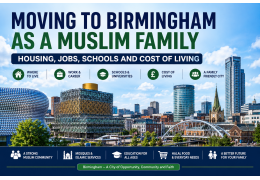
“Moving to Birmingham as a Muslim Family: Housing, Jobs, Schools & Cost of Living.”
It will examine rent, property prices, choosing the right area for your family, employment, universities, transport and everyday practical life.
The two guides are designed to work together:
this article explains Birmingham’s Muslim community; the next one will help you decide whether Birmingham could realistically become your home.
Birmingham is also only one destination in our wider series exploring the best UK cities for Muslims and Muslim families.
We will continue exploring other British cities in depth, comparing their Muslim communities, mosques, Islamic education, halal life and family environment.
Because there is no single perfect city for every Muslim family.
But when it comes to the strength, diversity and depth of established Muslim community life, Birmingham unquestionably deserves a prominent place in the conversation.




Leave a comment